


Tanzania is one of the places on Earth where the natural world has no need for hyperbole. Here, millions of animals follow ancient routes across the savannah, volcanic landscapes shelter extraordinary ecosystems and the Indian Ocean washes the shores of an archipelago whose history is as fascinating as its beauty. With the introduction of Tanzania and Zanzibar to its luxury holiday portfolio, Beachcomber Tours is opening the door to one of Africa’s most extraordinary destinations.
The Great Migration
The Serengeti, whose name derives from a Maasai word meaning “endless plains”, is the setting for one of the greatest wildlife phenomena on the planet. Every year, vast herds of wildebeest, accompanied by zebras and gazelles, undertake a circular migration in search of fresh grazing and water. Their journey, dictated by rainfall and the availability of pasture, is a remarkable demonstration of nature’s interconnectedness.
Between January and March, the southern Serengeti becomes an enormous nursery as hundreds of thousands of wildebeest calves are born. Later, the herds move north, confronting predators and the treacherous waters of the Mara River. The drama here is the stuff of award-winning documentaries, the kind that inspires children to protect nature, to become biologists and to realise how small we truly are in the grand scheme of things. But the allure of the Serengeti goes far beyond. Its lions, leopards, cheetahs and elephants inhabit an ecosystem that has evolved over millennia.
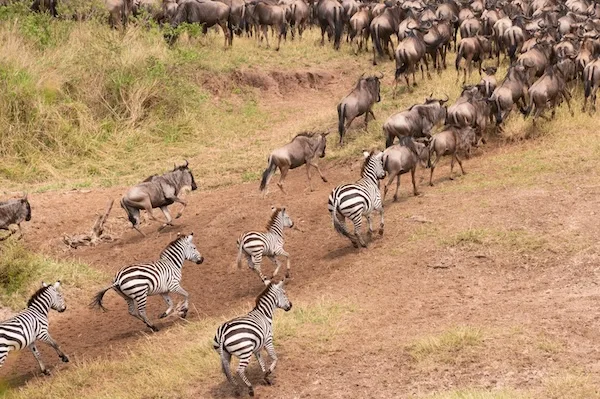
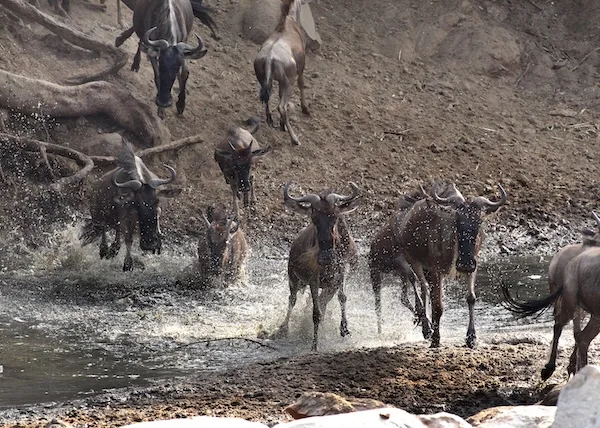
The Great Migration sees vast herds of wildebeest and zebras traverse the Serengeti, braving treacherous river crossings in their relentless search for fresh grazing grounds. (*)
Nearby, the Ngorongoro Crater offers another natural wonder. Formed approximately 2.5 million years ago following the collapse of a massive volcano, this immense caldera encloses a remarkable concentration of wildlife. Descending into its grasslands and forests is rather like entering a self-contained world, where buffalo, elephants, lions and the endangered black rhinoceros share a landscape shaped by geological forces.
Tanzania’s lesser-known wildernesses are equally interesting. In Ruaha National Park, ancient baobabs punctuate the landscape and the Great Ruaha River attracts elephants, crocodiles and some of the country’s largest lion populations. Further south, Nyerere National Park offers an unusual perspective on safari: exploring the Rufiji River by boat, observing hippos and crocodiles at water level while elephants gather along the banks.
For those seeking a shorter introduction to African wildlife, Saadani National Park offers the unusual prospect of a safari beside the Indian Ocean, conveniently accessible from Zanzibar.
Zanzibar: An Island Written in History
Across the water, Zanzibar reveals a different chapter of East Africa’s story. Known for centuries as the Spice Island, its strategic position along Indian Ocean trading routes attracted merchants from Arabia, Persia, India and beyond. Their influence remains embedded in the architecture, cuisine and cultural traditions of this predominantly Muslim archipelago.
Nowhere is this heritage more evident than in Stone Town, a UNESCO World Heritage Site. Its labyrinthine streets, intricately carved wooden doors and coral-stone buildings bear witness to centuries of cultural exchange. Behind the romantic façades lies a more difficult history, but one that needs to be told: Zanzibar was once a major centre of the East African slave trade. Understanding this past is essential to appreciating the island’s identity.
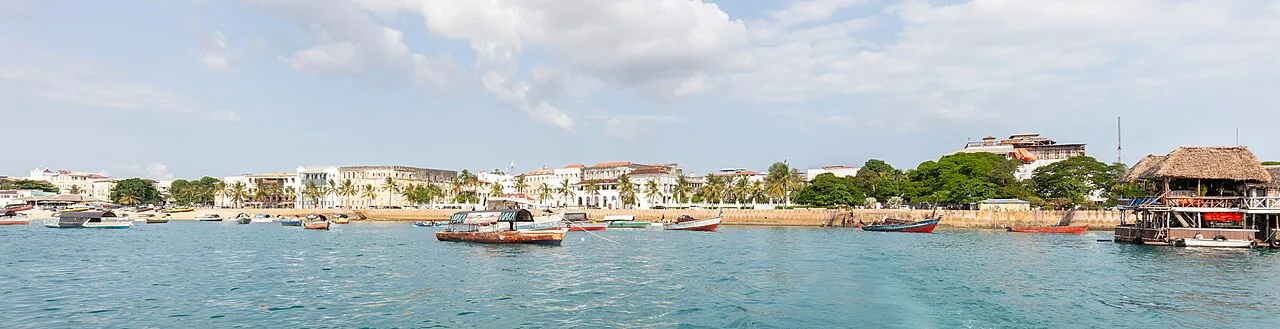
Stone Town’s historic harbour owes its prosperity to the monsoon winds, which for centuries carried merchant dhows between East Africa, Arabia and India. © Diego Delso / CC BY-SA.
The spice plantations provide another fascinating window into Zanzibar’s history. Cloves, cinnamon, nutmeg and cardamom transformed the islands into a valuable trading centre during the nineteenth century. Today, guided visits reveal how these aromatic plants grow, while local markets offer a sensory introduction to the flavours that define Swahili cooking.
Beyond Stone Town, the island’s character changes with its coastline. Kendwa and Nungwi, in the north, are renowned for their white sands and relatively gentle tidal variations. On the eastern shores, the dramatic retreat of the tide exposes broad expanses of sand and reef, where traditional fishing communities continue practices passed down through generations.
The surrounding waters invite further exploration. Traditional wooden dhows sail past the coast at sunset, while snorkelling excursions around Mnemba Island reveal coral gardens and colourful marine life. Inland, Jozani Forest provides sanctuary for the Zanzibar red colobus, a primate found naturally only in the archipelago.
The Art of Travelling Well
Beachcomber Tours’ new programme allows travellers to explore these contrasting environments through carefully planned itineraries, including short fly-in safaris and longer journeys through Tanzania’s northern and southern national parks.
On Zanzibar, two properties illustrate the variety of accommodation available. Zuri Zanzibar, overlooking Kendwa Beach, offers 56 bungalows and villas surrounded by tropical gardens, with a locally inspired design and a strong emphasis on wellbeing. Meanwhile, The Mora, on Muyuni Beach, provides a more expansive resort experience, with spacious suites, multiple swimming pools and easy access to excursions around Mnemba Island.
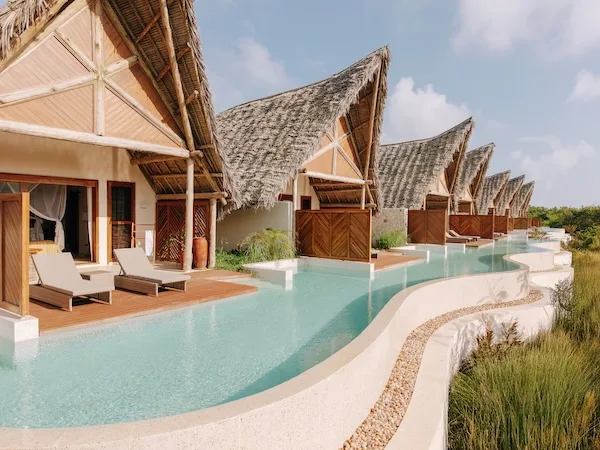
Left: Swim-up villas at Matemwe Attitude, an adults-only resort on Zanzibar’s east coast, overlooking the coral-rich waters of Mnemba Island.
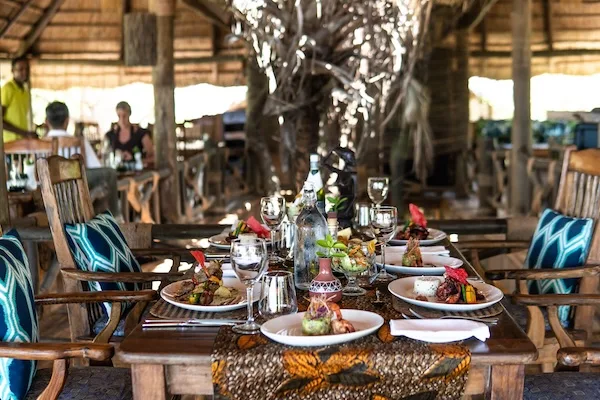
Right: The thatched restaurant at Saadani Safari Lodge, on the southern boundary of Tanzania’s only national park bordering the Indian Ocean, where wildlife safaris can be combined with beach escapes.
I challenge anyone to go there and not fall in love with the place. Tanzania rewards curiosity, whether through the extraordinary evolutionary theatre of the Serengeti, the geological drama of Ngorongoro or the layered cultural history of Zanzibar. It is a reminder that the greatest luxury is the opportunity to witness and understand the magic of nature and the communities that have developed alongside it, alongside it, living in harmony with their surroundings rather than seeking to conquer them.
Find out more about Beachcomber Tours in Tanzania and Zanzibar, HERE.
Author: Julia Pasarón
Curious about where else Beachcomber Tours can take you? Check out Golf and Chill at Beachcomber Tours Resorts in Mauritius and our individual reviews of Trou Aux Biches Beachcomber Golf Resort & Spa and of Paradis Beachcomber Resort & Spa.
(*) Left image © Kavish Shah / Pexels. Right image © Jan Fleischmann (Wolves201) / CC BY-SA 4.0


Show Comments +