


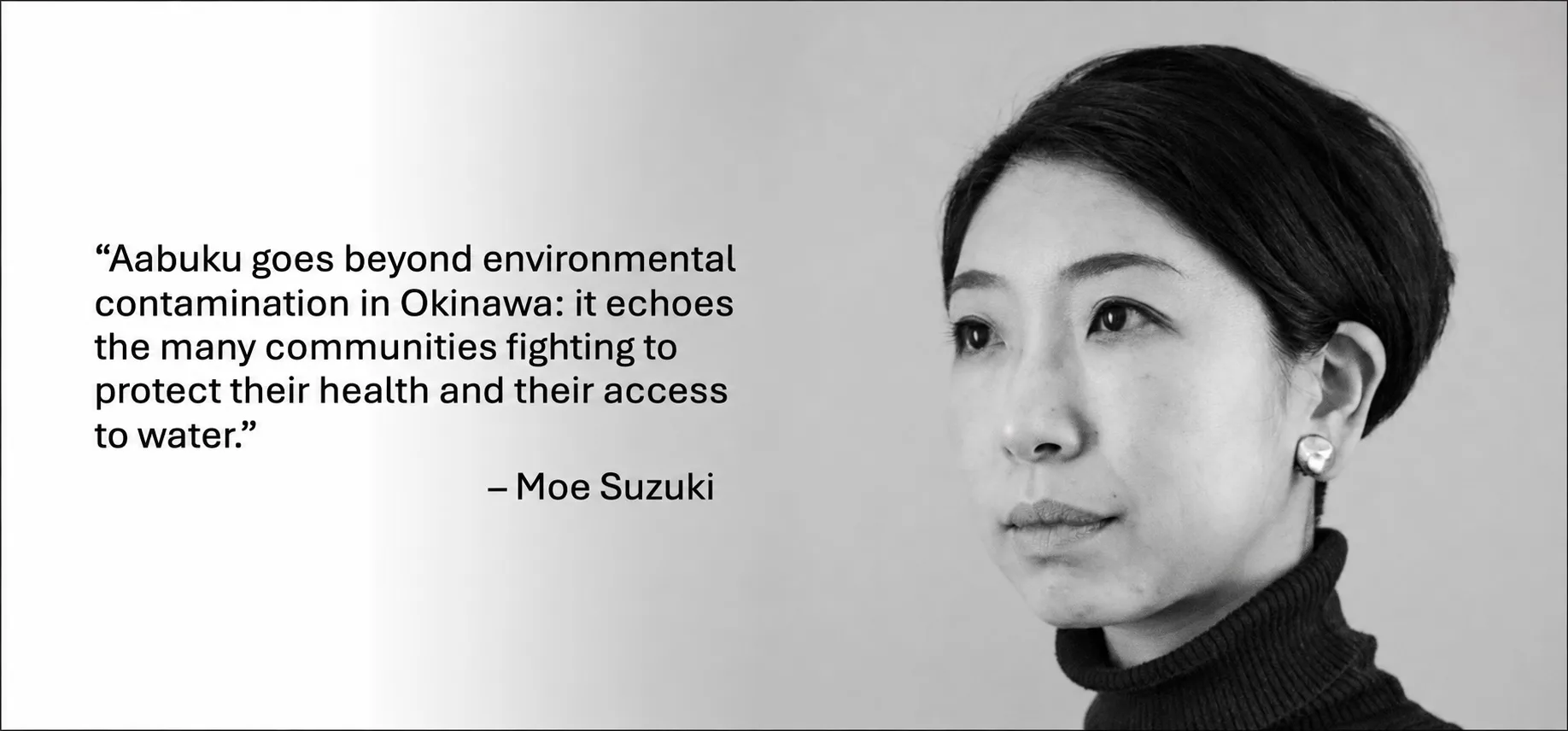
How do you photograph something that has neither colour nor smell, respects no geographical boundaries and may outlive the person holding the camera? For Japanese photographer Moe Suzuki, winner of the 2026 Louis Roederer Foundation Thinking Sustainability Prize, this question became the basis of Aabuku, an unsettling visual investigation into the contamination of water and soil in Okinawa by PFAS, the so-called ‘forever chemicals’.
Announced on 12 November at Reid Hall, Columbia University’s centre in Paris, during the celebrations marking the bicentenary of photography, the award recognises a body of work that challenges the very premise of the medium: that seeing is believing.
The origins of Aabuku lie in a conversation between Suzuki and her mother, who lives in Okinawa. “seemingly unremarkable conversation. “When my mother, who lives in Okinawa, “When she told me she had stopped using tap water for cooking because of the contamination, I set out to investigate,” the artist explains.
Per- and polyfluoroalkyl substances (PFAS) owe their extraordinary persistence to extremely strong carbon-fluorine bonds. Used in products ranging from non-stick cookware to firefighting foams, certain compounds within this family have been associated with serious health concerns. In Okinawa, where contamination linked to American military installations became public knowledge in 2016, their presence has disrupted the relationship between inhabitants and their environment.
The title Aabuku derives from an Okinawan word describing the bubbling appearance of foam. Suzuki discovered testimonies from residents recalling how, as children in the 1980s, they played with foam that had escaped from military bases. What once appeared a source of amusement has acquired a sinister significance. Childhood memories, normally a refuge, become a source of anxiety.
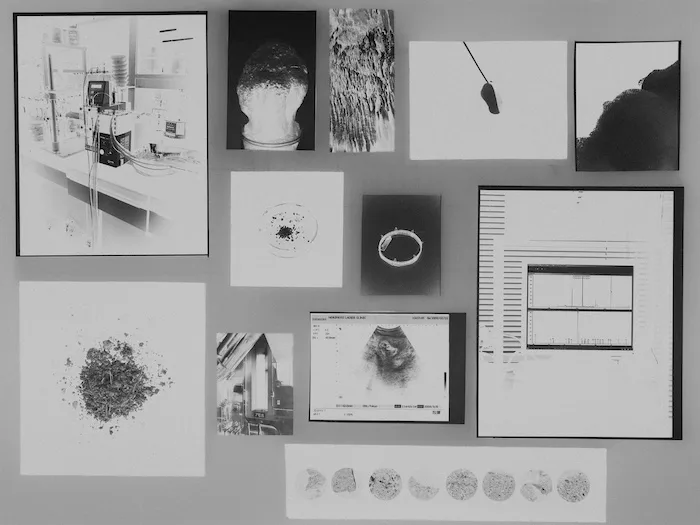
Suzuki’s photographs resist the visual vocabulary traditionally associated with environmental catastrophe. Water trickles across a sunlit courtyard; residents stand surrounded by luxuriant vegetation; an apparently ordinary street is rendered in negative, overlaid with cartographic imagery. Hand-drawn maps, scientific documentation and personal testimonies interrupt the photographic sequence. Individually, these images reveal little about the contamination. Collectively, they construct a portrait of a community living with uncertainty.
Her approach recalls the work of American marine biologist Rachel Carson, whose seminal 1962 book Silent Spring alerted the world to the ecological consequences of indiscriminate pesticide use. Carson made the absence of birdsong a powerful metaphor for environmental destruction. Suzuki similarly draws our attention to what is imperceptible.
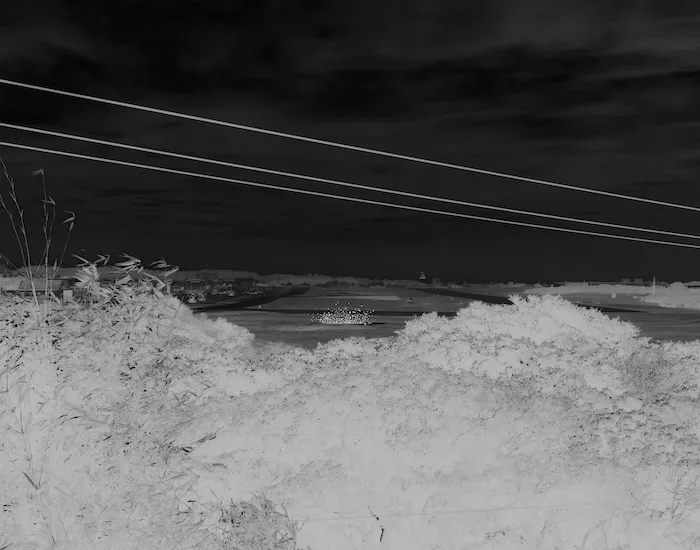
Left: Inverted landscape punctuated by hand-drawn dots representing the invisible presence of forever chemicals. © Moe Suzuki, Aabuku, 2024.
Right: Suzuki combines scientific evidence and personal archives to explore the effects of PFAS contamination. © Moe Suzuki, Aabuku, 2024.
Environmental humanities scholar Rob Nixon coined the term ‘slow violence’ to describe destruction that accumulates gradually, often escaping public attention because it lacks the drama of a sudden catastrophe. Aabuku could be considered a photographic interpretation of this concept. Suzuki’s image are an invitation to sustained observation.
The exploration of invisibility is consistent with her earlier work. Having studied at the London College of Communication, Suzuki returned to Tokyo in 2011 and taught herself bookbinding. Her deeply personal project Sokohi, documenting her father’s progressive loss of sight, was selected by New York’s Museum of Modern Art among its favourite photobooks of 2022. Where Sokohi examined the experience of losing vision, Aabuku interrogates the limitations of vision itself.
Established in its current format in 2024, the biennial Thinking Sustainability Prize is distinguished by its geographical and intellectual breadth. This year, 18 international nominators put forward 54 photographers, with one finalist selected to represent each of six continents. The winner receives €8,000 and a specially commissioned critical essay, while the remaining finalists each receive €1,000.
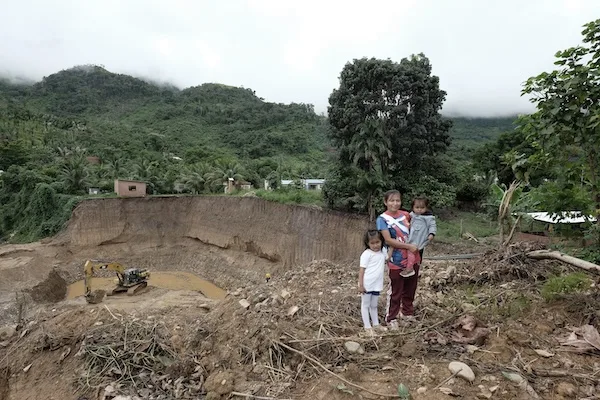
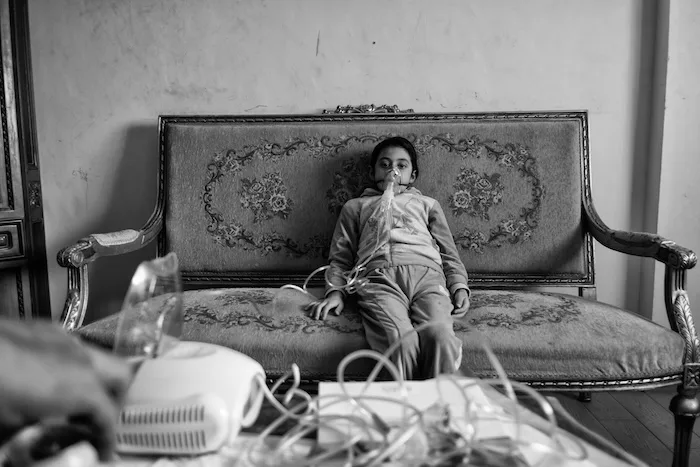
Left: A woman and two children beside a gold-mining excavation in the Bolivian Amazon, where deforestation and mercury contamination threaten Indigenous communities. © Wara Vargas Lara, Silent Victims of the Gold Rush, 2023.
Right: Amal, an 11-year-old child receiving respiratory treatment in Wadi El-Qamar (Moon Valley), Alexandria, Egypt, where emissions from a neighbouring cement factory have severely affected residents’ health. © Mohamed Mahdy, Moon Dust, 2016–2025.
The other shortlisted projects explore industrial pollution in Egypt, mercury contamination associated with gold mining in Bolivia, ecological and colonial tensions in northern Australia, environmental fragility in New York’s Hudson Valley and the changing landscapes and cultural identity of Greenland.
The Foundation, celebrating its 15th anniversary, has also expanded its programme beyond photography and scientific research, introducing a writing residency inaugurated by acclaimed novelist Amitav Ghosh and supporting biodiversity and living heritage initiatives.
The Thinking Sustainability Prize recognises that environmental crises are also crises of perception. Scientific research can establish the presence of contaminants; legislation can determine acceptable thresholds. Art, however, can articulate what it feels like to inhabit a landscape whose apparent familiarity can no longer be trusted.
Author: Julia Pasarón
Lead image © Moe Suzuki, Aabuku, 2024.
If you are interested in how contemporary artists challenge our perception of the world and our relationship with it, you may also enjoy reading Nan Goldin: You Never Did Anything Wrong, Amar Kanwar: Into the Darkness and Sylvia Safdie: TERRA.


Show Comments +