


For Jasmine Blackborow, storytelling has always been much more than inhabiting a role. As her career gathers pace, from The Gentlemen and Moss & Freud to Dolly Alderton’s forthcoming Pride and Prejudice, she is also stepping behind the camera. Her award-winning short Lovely, inspired by her grandmother’s illness, looks at care, grief and humour through an emphatically female lens. Here, Blackborow speaks about the experiences that have shaped her and the stories she wants to tell.
Jasmine Blackborow’s route into acting was not one she had imagined for herself. Raised in North London in a lower-middle-class family with no industry connections, she loved drama and media studies at school but never saw performance as a realistic profession. It was only later, while studying English Literature and Drama, that encouragement from a tutor prompted her to consider drama school.

Ironically, filmmaking had already found her. At 18, a music video made for an A-level media studies project won her a BBC Blast/BAFTA directing bursary and a month-long placement at Ridley Scott’s RSA Films. Acting ultimately took over, followed by years of theatre and an increasingly prominent screen career. But the instinct to make her own work never disappeared.
In 2026, it returned with Lovely, Blackborow’s first narrative short as writer-director. Inspired by her grandmother, who lived with progressive supranuclear palsy, a rare neurological condition affecting movement, speech and communication, the film asks what happens to a family when love, exhaustion, frustration and grief are forced to coexist.
Two days before our interview, Blackborow had won Best Director at the Women X Film Festival, while Lovely took Best of the Southwest at Encounters Film Festival. “I was honestly gobsmacked,” she says. “Not in a million years did I imagine we would win awards like that. The competition was so strong.”
For a first film, Lovely is remarkably assured, not least because Blackborow resisted making illness solemn. “You can’t just sit and cry, because if you start crying, you’ll never stop,” she says. “You have to get on with it, and when you do, life still happens and it can be funny. You find yourself in situations that would never exist without the illness.”

It is a fine balance. “Some of the things that make you cry are also the things that make you laugh. Humour gives you a lightness of touch; it opens people up and lets you bring them into something more painful.” One scene captures it perfectly: a woman struggles to communicate with her daughters and granddaughter, only for a carer to understand her instantly. The frustration is real, but so is the absurdity.
Besides her own experience, Blackborow researched the condition together with the lead actress (Abigail McKern) and spoke to other families living with PSP. Authenticity meant resisting the neat emotional shorthand often imposed on stories about illness and care. “A lot of love can come from the darkest places,” she says. “And humour can come from there too.”
Lovely is also unmistakably a story about women. Its cast is entirely female, reflecting Blackborow’s own family history: on her maternal side, only women have been born for six generations. She grew up knowing her great-grandmother, grandmother and mother, and is now a mother herself.
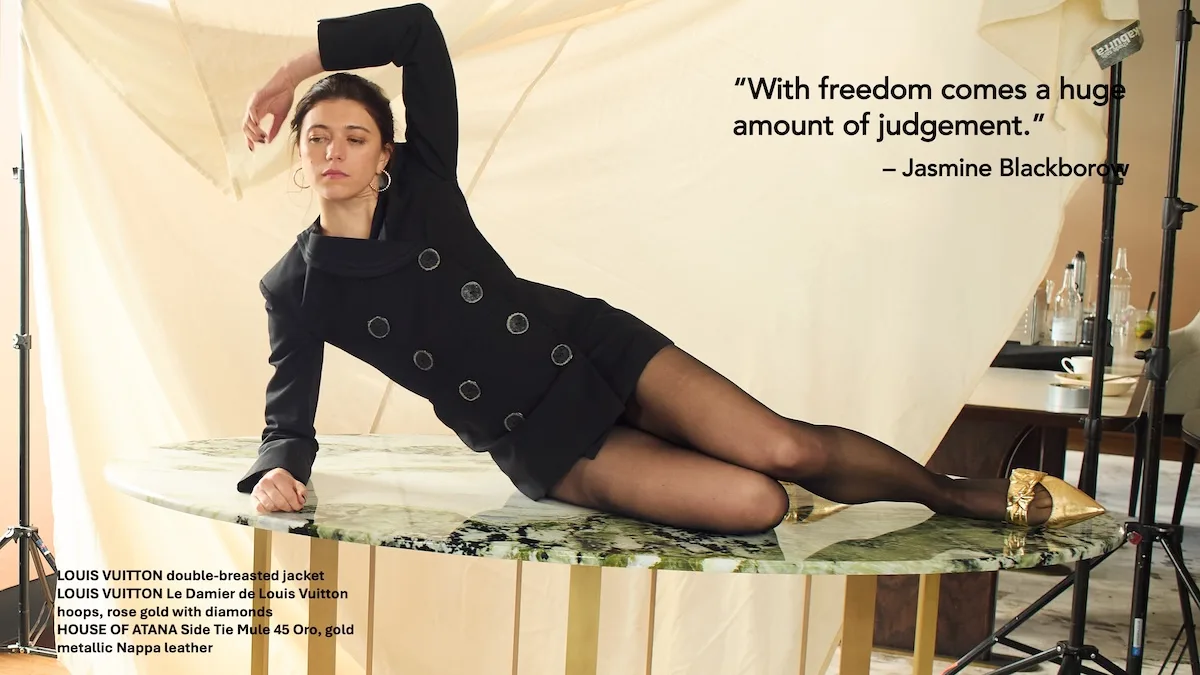
“Being surrounded by those generations taught me that being a woman is complicated, and that so much depends on the time you are born into,” she says. “But they all encouraged me to be myself and to hold my own.” Yet Blackborow is wary of pretending that progress has erased the underlying tensions.
“Women’s choices have always been complicated. They were two hundred years ago and they are today. We have more choices now, but I’m not sure our roles have shifted as much as we like to think. And with choice comes a huge amount of judgement.”
The conversation continues in print: From playing Charlotte Lucas in Netflix’s forthcoming Pride and Prejudice to the compromises of motherhood and the opportunities denied to young creative talent, Jasmine Blackborow has plenty more to say. Read Julia Pasarón’s full interview, accompanied by a stunning photography by Amelia Troubridge, exclusively in the Winter issue of I-M Inquisitive Minds. ORDER YOUR WINTER ISSUE, [HERE].
We’d like to thank Grosvenor House Suites for their hospitality: grosvenorhousesuites.com | reservations@grosvenorhousesuites.com | Tel. +44 (0) 20 7518 4444
Team:
Photography: Amelia Troubridge | ameliatroubridge.com
Styling: Riana Pervez | rianapervez.com
Videographer: Israr Azam | israrazam.me
Hair Styling: Allie Harknett | @allie.hairstylist
Makeup: Dani Guinsberg | daniguinsberg.com
Photography Assistant 1: Amy Amissah | @amiissah
Photography Assistant 2: Michael Farra | michaelfarraphotography.co.uk
Styling Assistant: Frédéric Huether @frederic.huether
More extraordinary women in I-M Magazine: If you enjoyed our conversation with Jasmine Blackborow, discover more thought-provoking interviews with women who refuse to be defined by expectations:
LAURA DERN on motherhood, activism, artistic freedom and the changing face of Hollywood. [HERE]
LIZZY JAGGER on equality, activism and the courage to challenge convention. [HERE]
INDIRA VARMA on identity, female empowerment and breaking industry stereotypes. [HERE]
In the lead image, Jasmine wears a FENDI cotton dress and leather collar | fendi.com


Show Comments +