


Madeleine Grynsztejn exudes energy, passion and commitment. Since joining the Museum of Contemporary Art (MCA) Chicago in 2008, she has focused on promoting emerging talent and making the museum more welcoming and accessible. In 2015, her attention turned to achieving gender parity within its walls.
The numbers speak for themselves. Between 2020 and 2025, 54 per cent of the MCA’s solo exhibitions featured women artists, compared with a national average of 14 per cent. “This isn’t woke and this isn’t about quotas,” Madeleine states. “This is marrying excellence to equity, and you need to commit to it.”
Looking at past exhibitions, including those dedicated to Yoko Ono, Firelei Báez, Carolina Caycedo, Nicole Eisenman and Faith Ringgold, it becomes clear that many of these artists share a commitment to social, historical and political storytelling. Very much in line with Madeleine’s vision.
As her tenure comes to an end in December, the Bluhm family has pledged a $5 million endowment in her honour. The Madeleine Fund for Women Artists will support exhibitions and acquisitions by women artists, ensuring that the work of the MCA’s Women Artists Initiative continues long after her departure.
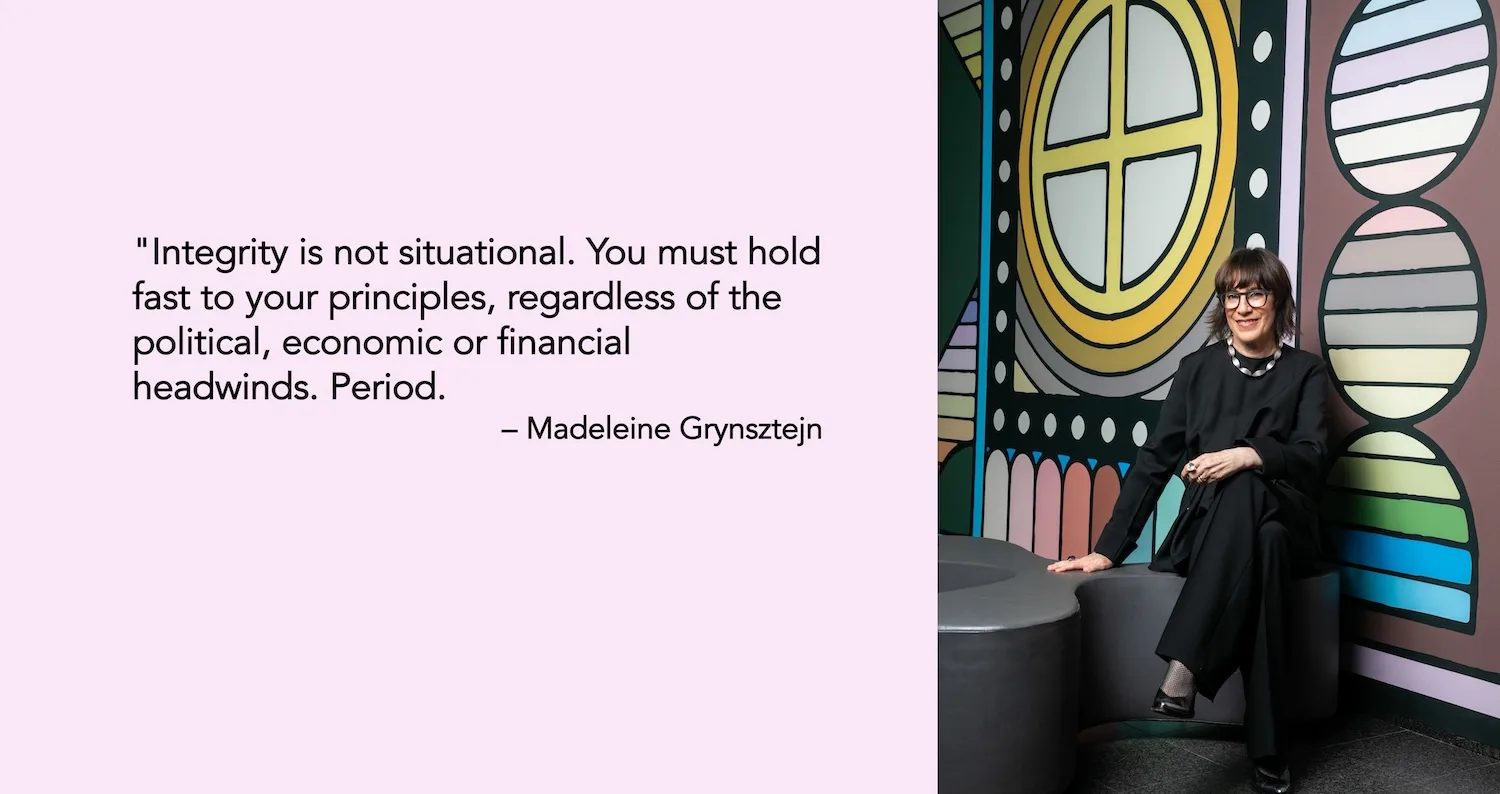
The first thing I want to know is how she feels about leaving after 18 years working full-on (I doubt this woman would ever do anything otherwise). “I am not retiring,” she assures me. “I am rewiring. “In the next stage of my career, you’ll see me getting closer to artists again, as when I started as a curator, and putting my knowledge of institutions to good use.” She modestly attributes the success of her tenure to her partnership with the museum’s staff and board of trustees, particularly Leslie Bluhm, whose family has made the endowment possible.
Before becoming director of the MCA, Madeleine was senior curator of painting and sculpture at the San Francisco Museum of Modern Art, where she organised exhibitions dedicated to Olafur Eliasson and Richard Tuttle. Earlier, she curated the 1999 Carnegie International and worked at the Art Institute of Chicago. “I miss being in the artist’s studio and writing about artists,” she adds, with a tinge of nostalgia in her voice.
For me, her most interesting contribution concerns who gets to write art history and how museums exercise their cultural power. After all, art history is partly determined by decisions about who is collected, exhibited and ultimately, remembered.
Another striking figure concerns permanent collections. The MCA has acquired works by women artists at an annual rate of 50 per cent, against a national benchmark of 14 per cent.
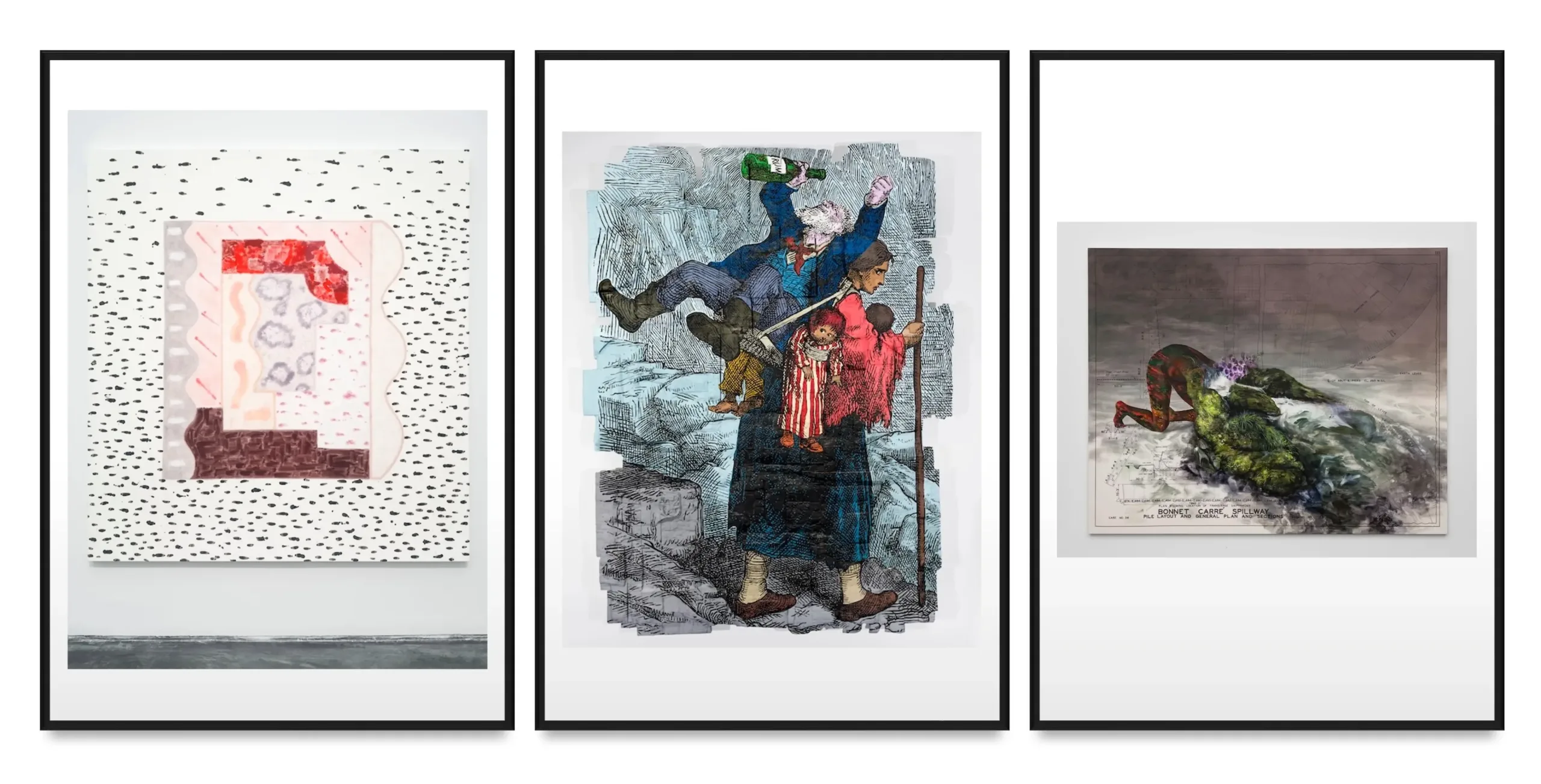
Left: Rebecca Morris, Untitled (#06-13), 2013. MCA Chicago. Gift of Marilyn and Larry Fields. Photo: Shelby Ragsdale / MCA Chicago.
MIddle: Andrea Bowers, Wife with Heavy Burden (“Get Thee Behind Me (Mrs.) Satan!” Thomas Nast, 1872. Published by Harper’s Weekly.), 2018. MCA Chicago. Gift of Marilyn and Larry Fields. Photo: Shelby Ragsdale, © MCA Chicago.
Right: Firelei Báez, The Earth That Remains, MCA Chicago. Gift of Laura and Michael Werner, Photo © Bob. (Robert Chase Heishman).
“Permanent collections are the soul of a museum,” Madeleine explains. “They are the tool to tell the story of art, to change people’s hearts and minds, and in turn, society. If you don’t change your permanent collection to reflect 50 per cent of the world’s population, you, as a public trust, are not serving humankind.”
This is about more than correcting historical omissions. It challenges the criteria by which artistic importance has traditionally been established.
Madeleine returns to the data. According to the MCA Chicago’s analysis, exhibitions by women artists have generated, on average, 16 per cent more admission revenue than those by men since the initiative began in 2015. There is a commercial argument here, too. Women frequently constitute a majority of museum audiences, so why should they remain a minority of the artists represented?
Madeleine is not resting on her laurels. She also wants greater diversity in age and race. “Right now, the age of the average female visitorship ranges between 45 and 60, and they are mostly white. We need to work on that.”
She is equally adamant that the established artistic canon requires reconsideration. “We have incorporated artists such as Faith Ringgold and Yoko Ono because the canon needs to be course corrected.”
But how did an aspiration become a permanent institutional commitment?
“When my team and I started this in 2015, it was pre-#MeToo, pre-Time’s Up”. By 2020, Madeleine and her team had identified a persistent fundraising disparity affecting exhibitions by women artists, comparable, she says, to the gender pay gap. To address it, they formalised the Women Artists Initiative, supported by five philanthropists, including one man, who contributed annually to close the funding shortfall.
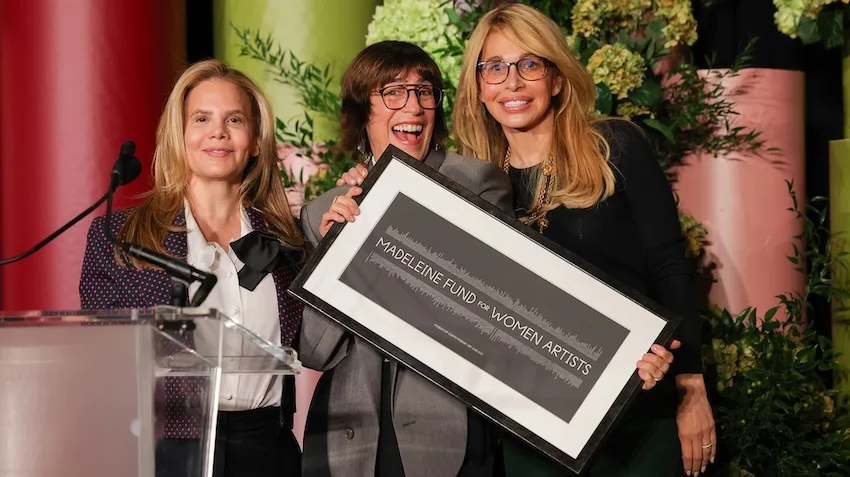
Madeleine Grynsztejn (centre) with sisters Meredith Bluhm-Wolf (left) and Leslie Bluhm (right) on October 2026 at the MCA Chicago Visionary Award Luncheon, where they announced the Madeleine Fund for Women Artists in Grynsztejn’s honour.
To address it, they formalised the Women Artists Initiative, supported by five philanthropists, including one man, who contributed annually to close the funding shortfall.
Now, thanks to Leslie Bluhm and her family, the initiative has a $5 million endowment. Unlike a gift earmarked for a single exhibition, an endowment is designed to generate ongoing financial support while preserving its underlying capital.
What began as a personal conviction has become an institutional commitment with the means to endure. Yet this raises another question. Once reform becomes established policy, how does an institution retain the courage to challenge itself?
Madeleine doesn’t hesitate. “Integrity is not situational. You must hold fast to your principles, regardless of the political, economic or financial headwinds. Period.
“As a leader, the first thing you do is establish your mission and your principles, so that when the crisis comes, not if the crisis comes, you don’t change course.”
She refers directly to the Trump administration and the withdrawal of funding from cultural institutions sharing the MCA’s values. “We did not change our commitment to being a 50 per cent woman-identified artist museum.”
For Madeleine, leadership depends on principles shared by staff and trustees: revelatory art, social belonging and ethical operations.
The museum’s commitment to becoming fully bilingual in English and Spanish is another expression of this philosophy, responding to Chicago’s substantial Spanish-speaking population. ” Good business and good culture serves your public,” she concludes.
Before saying goodbye to this tour de force of a woman, I ask about her successor, whose appointment has yet to be announced. She tells me the search is approaching its conclusion.
I doubt she could ever truly be replaced. But perhaps that is the point of her legacy. The next director will inherit not only an inspiring example but also an institution whose commitments have been translated into policy, acquisitions and permanent funding.
Madeleine may be rewiring, but the work she started is designed to continue.
Author: Julia Pasarón
Pictures at event © Jeremy Lawson / Courtesy MCA Chicago.
Picture of Madeleine with quote © Maria Ponce.
If you enjoyed reading about Madeleine Grynsztejn’s legacy at MCA Chicago, you may also be interested in our interview with Jadine Collingwood, our feature on textile artist Kate Jenkins, and our review of Slow Dance, currently showing at MCA Chicago.


Show Comments +