


Hublot and Jeff Koons have more in common than one might guess at first sight. Both built their reputations by taking materials that did not traditionally belong in their respective worlds and forcing us to look at them differently. For Hublot, the provocation began in 1980 with gold on vanilla-scented rubber. For Koons, it has meant turning vacuum cleaners, basketballs, porcelain ornaments and children’s inflatables into objects of almost obsessive technical perfection.
The Classic Fusion Balloon Dog by Jeff Koons makes that shared instinct literal. Hublot has re-engineered the 42mm Classic Fusion around the physical language of Balloon Dog. The case, bezel, sapphire crystal, titanium screw heads and dial have all been given swollen, convex profiles, creating the impression that the watch itself has been inflated. Even the crown resembles a balloon valve, while a “tail” emerges at 10:30 and a miniature Balloon Dog forms the counterweight of the seconds hand.
That sounds playful, but Koons’s work has always hidden extraordinary engineering beneath its pop surface. Balloon Dog, conceived between 1994 and 2000 as part of his Celebration series, transformed a disposable party trick into a three-metre, roughly one-ton sculpture in mirror-polished stainless steel. The Whitney records that Balloon Dog (Yellow) required 60 precision-engineered components, fabricated and finished to preserve not merely the shape of a balloon animal but the illusion that air could circulate inside it. Earlier, for his 1985 Equilibrium works, Koons even consulted Nobel Prize-winning physicist Richard Feynman to work out how to suspend basketballs within tanks of distilled water and salt solution. His fascination with material science runs deep through his art.
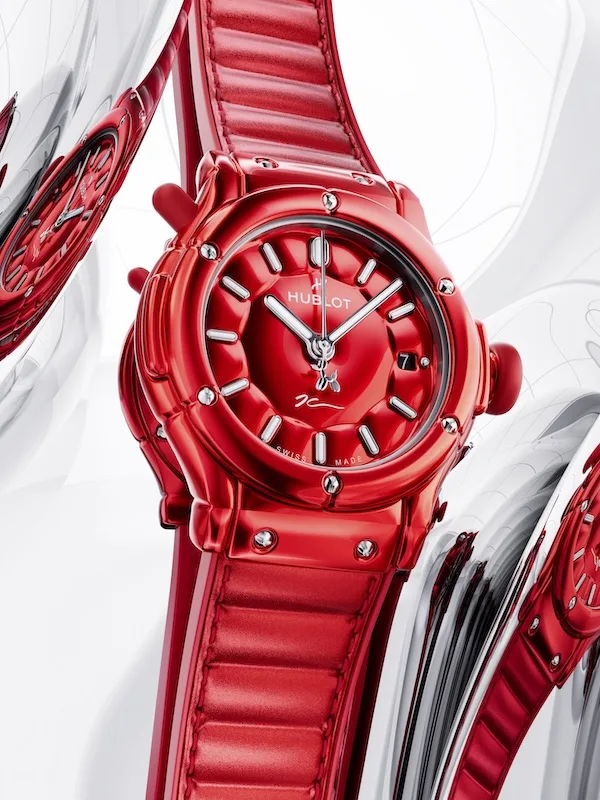

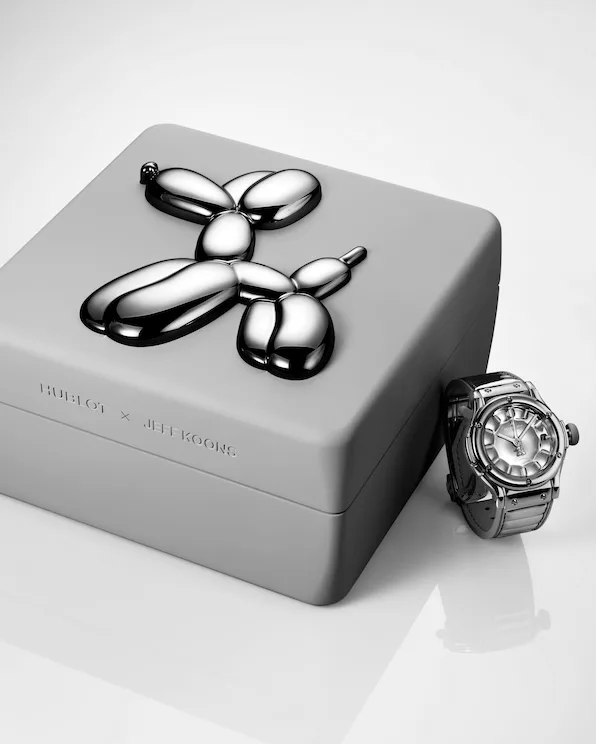
Jeff Koons brings the playful, mirror-polished language of his Balloon Dog to Hublot’s Classic Fusion, from the vivid red edition to the silver model and its specially designed presentation case.
Hublot shares this fascination. The manufacture has spent decades treating materials as a field of experimentation, from its original gold-and-rubber combination to scratch-resistant Magic Gold, coloured sapphire and vivid high-tech ceramics. Here, red and blue anodised aluminium were selected specifically for their saturated colour, alongside a mirror-polished steel edition. Each version is milled on five-axis CNC machines before being finished by hand, an industrial-to-artisanal process that feels very Koons.
Inside is Hublot’s automatic HUB1710 calibre, beating at 28,800 vibrations per hour with a 50-hour power reserve and a specially shaped oscillating weight that continues the inflated theme. The three references are limited to 200 pieces each and priced at £19,700.
Koons once made the fragile permanent by translating air into steel. Hublot has now attempted the reverse: making metal, sapphire and rubber appear soft, pressurised and almost weightless. A piece of horology persuaded to behave like his art.
Author: Julia Pasarón
Other new watch releases recently reviewed by I-M Inquisitive Minds include the Best Affordable Luxury Watches at GWD, Reinventing the House Icon, the Best on Independent Mechanical Engineering at GWD and an exclusive interview with Vanguart’s Axel Leuenberger about AI.


Show Comments +