


While the rest of the watch world had decamped to Switzerland for Geneva Watch Days, A. Lange & Söhne chose Hampton Court Concours d’Elegance to release a new version of its Triple Split chronograph, in 950 platinum with a rhodium-coloured dial and contrasting grey sub-dials in London.
This is the third execution of the watch since its inception in 2018. It debuted in white gold and a pink gold version was presented in 2021. The new Triple Split features a case (ref. 424.025F) measuring 43.2mm width and 15.6mm depth, polished and satin-brushed, with a sapphire crystal front and back. Production is capped at 100 individually numbered pieces worldwide; priced at €210,000. For the money – and while this is relative of course – it might offer the best horological value on the market.

A. Lange & Söhne at the Concours of Elegance at Hampton Court Palace, where the new platinum Triple Split made its world debut.
The true wonder of the Triple Split, and what makes it unique to Lange, is the added complexity to the complication. Lange have a pre-eminence in chronographs above any other brand. A conventional split-seconds chronograph lets you compare two events by splitting the seconds. Lange’s own Double Split, launched in 2004, extended that to minutes. The Triple Split goes one further, extending the split function to hours, and is the only chronograph in the industry that can do so.
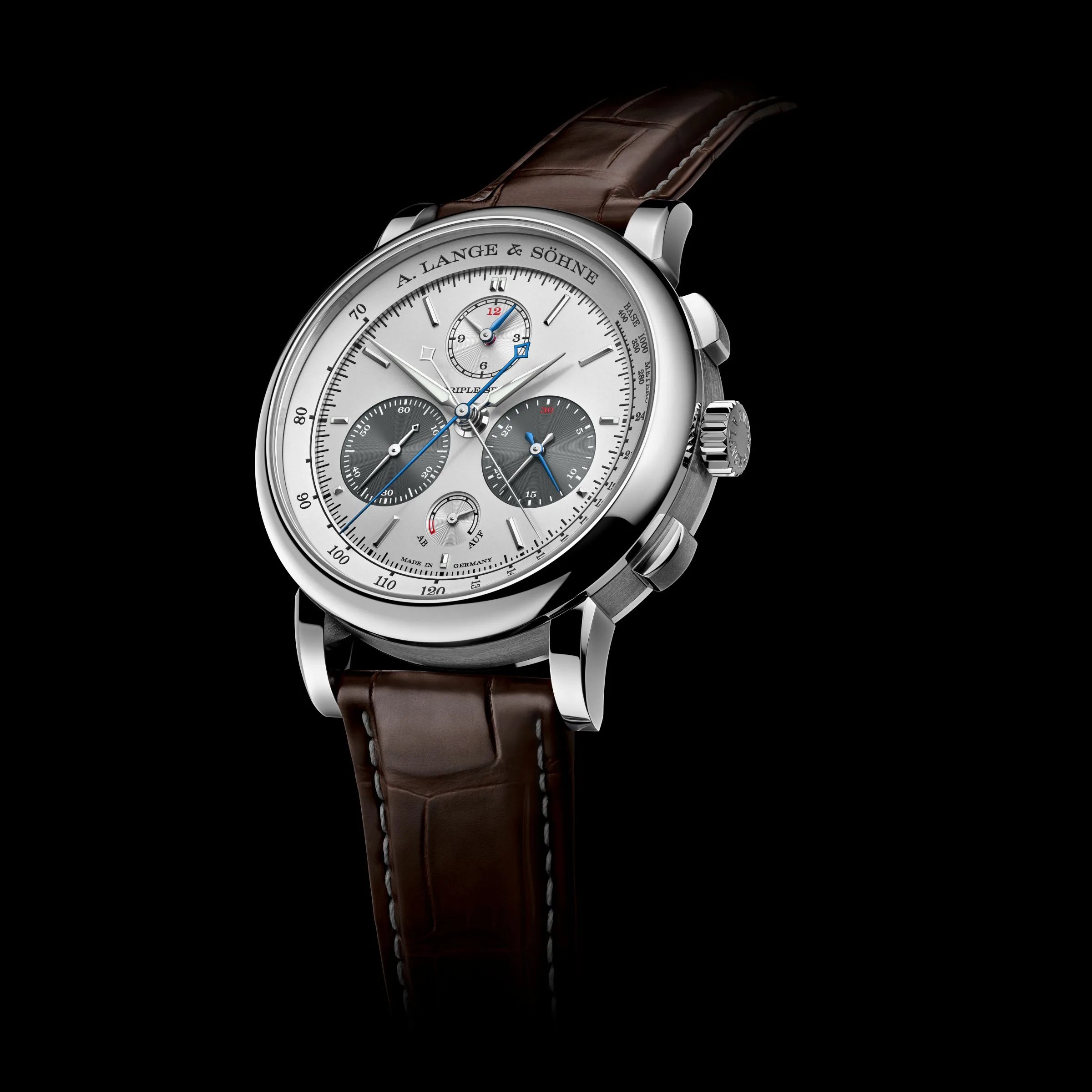
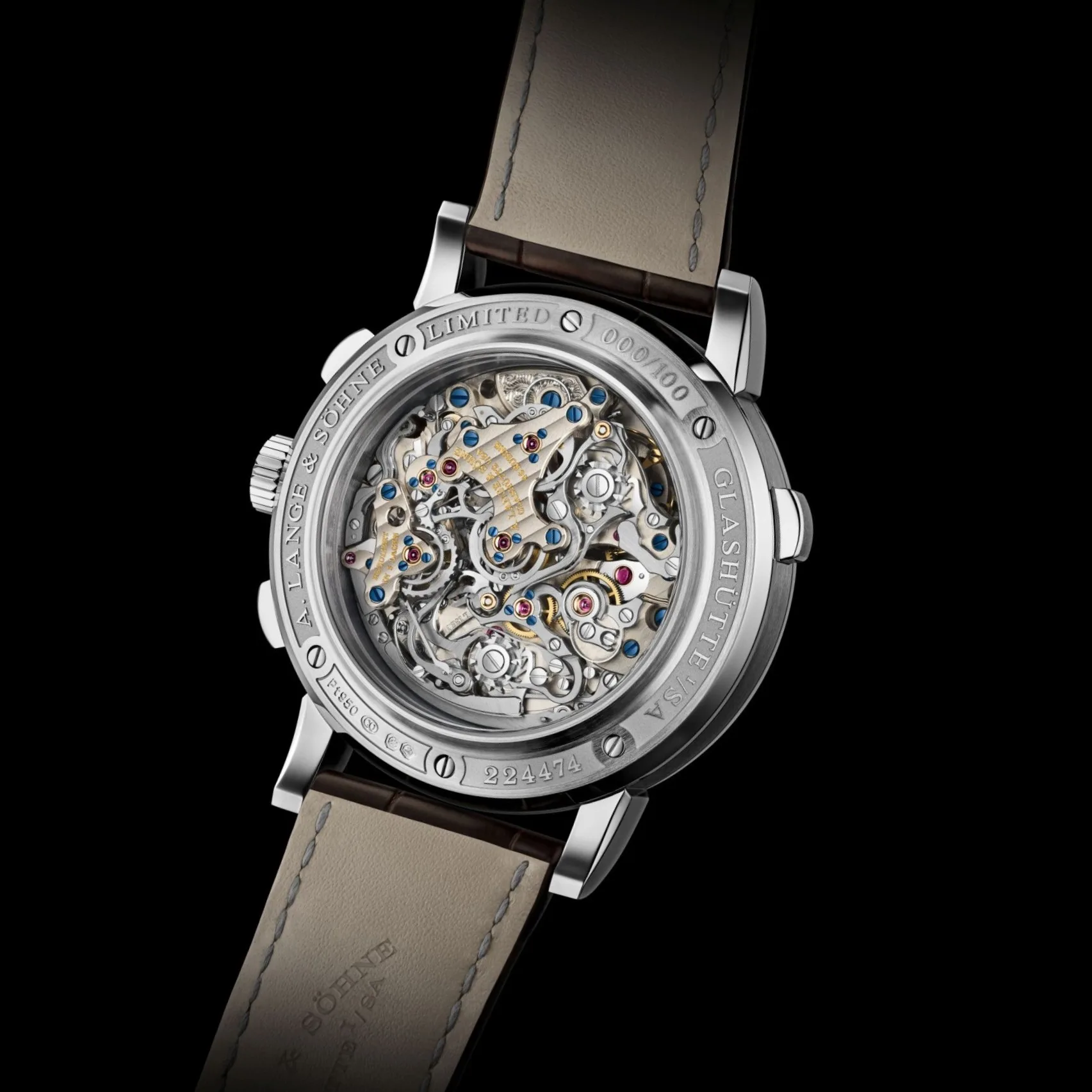
The new A. Lange & Söhne Triple Split in platinum: its rhodium-coloured dial with contrasting grey subdials (left), and the 567-part calibre L132.1 visible through the sapphire caseback (right).
It works through three full pairs of synchronised hands, one for seconds, one for minutes, one for hours, each pair finished in a different metal, so the two readings never get confused, one hand set in rhodium, the other blued steel. Press the rattrapante pusher at 10 o’clock and the trio of blued hands freezes in place while the rhodium-finished trio keeps running underneath. On the dial itself, the layout is built around that mechanism: hours at 12, the running seconds at 9, the chronograph minute counter at 3, and the power reserve at 6. It’s all driven by the manually wound, 46-jewel Calibre L132.1 with 567 components, and 55 hours of reserve.
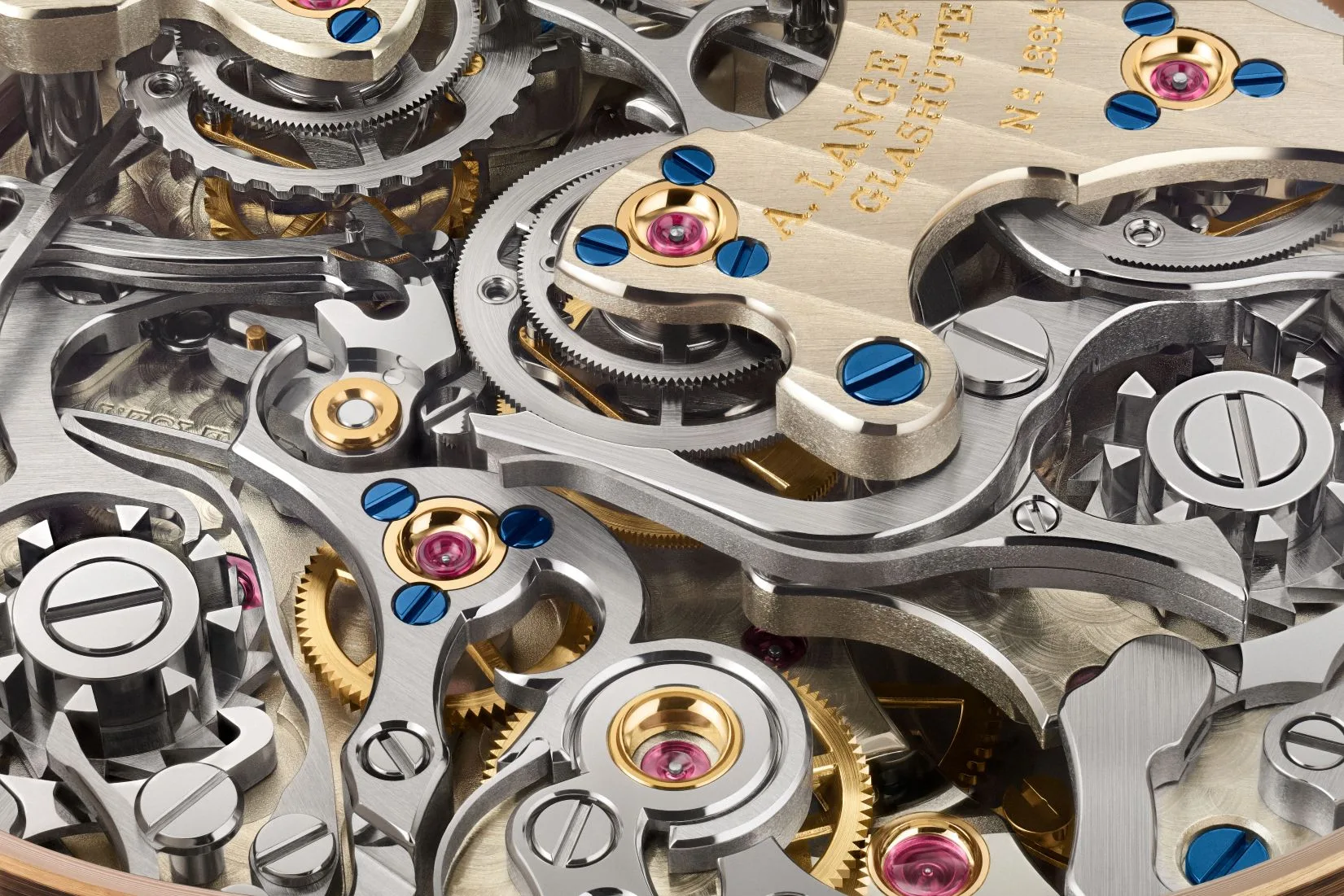
The intricate calibre L132.1 at the heart of the Triple Split, comprising 567 components and three pairs of synchronised chronograph hands.
The chronograph complication has relevance to Lange’s commitment to automotive concours. Start timing one car, then start a second hours later without resetting the first, and you can read off both elapsed times, and the exact gap between them, whenever each finish. For anything run on a staggered start, a rally stage, a hill climb, two drivers on the same circuit at different times of day, the Triple Split presents a genuinely rare piece of functionality.
It also sits comfortably with where Lange actually spends its time. The brand has sponsored the Concorso d’Eleganza Villa d’Este for close to 15 years and the Concours of Elegance at Hampton Court Palace since 2018. A long-run commitment to classic motoring absent from most other watch brands.
Author: Andrew Hildreth
Other recent complication watches reviewed by I-M Inquisitive Minds include Breguet and The Art of Gravity; the MB&F LM Perpetual Chromatic Edition; and the Roger Dubuis Excalibur Moonlight.


Show Comments +